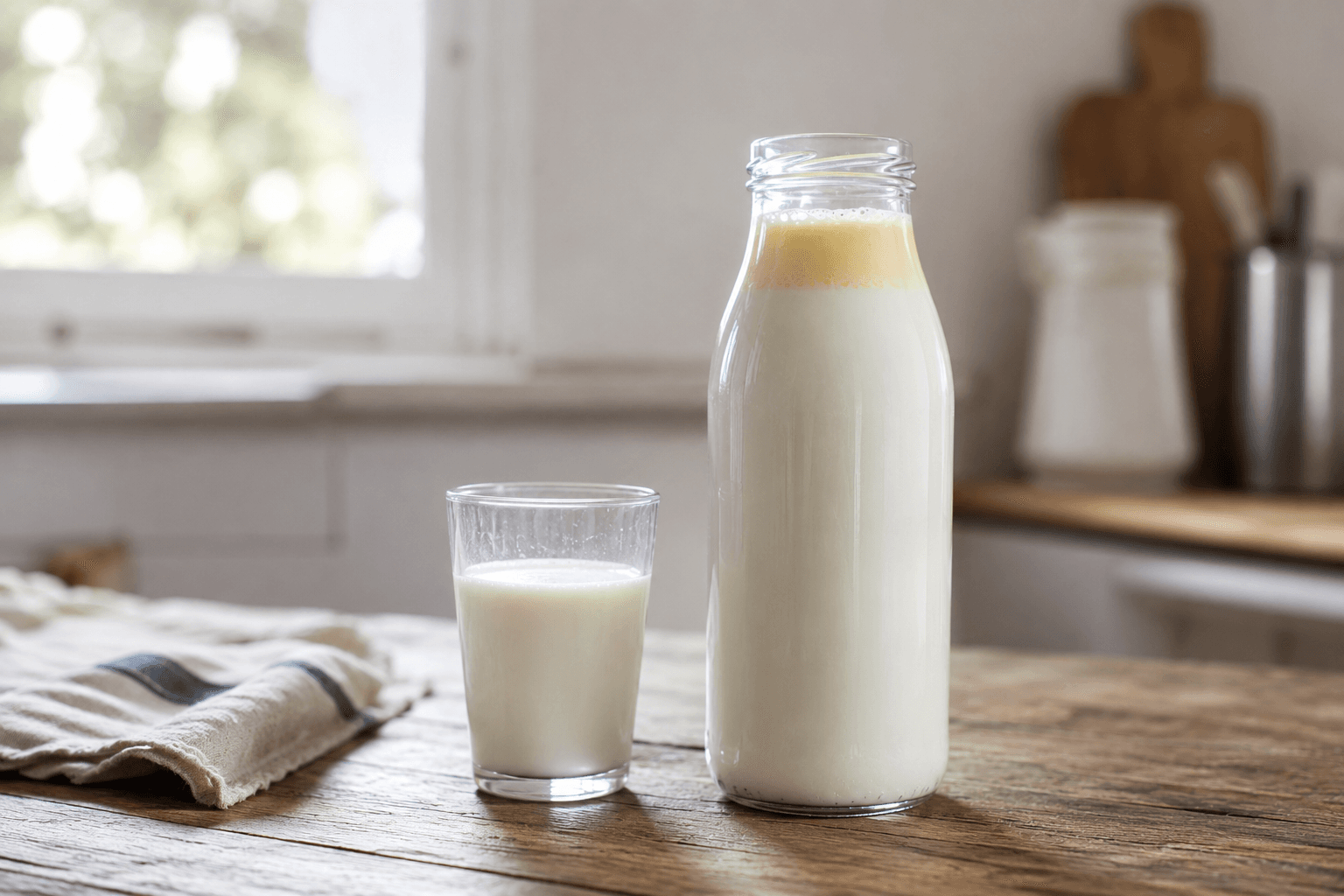
What Is Non(un)-Homogenised Milk? Cream Rise on the top
Fresh Dairy
What Is Non(un)-Homogenised Milk? Why Does Cream Rise to the Top?
Discover what non-homogenised milk is, why cream naturally rises to the top, and how it differs from homogenised milk. Learn about Kisaan's un-homogenised cow and buffalo milk range.
11 min readBy Kisaan
What Is Non(Un)-Homogenised Milk?
Non-homogenised milk is milk that has not gone through the homogenisation process.
Milk naturally contains fat in the form of tiny globules. During homogenisation, these fat globules are broken into smaller particles and distributed more evenly throughout the milk. This helps keep the cream from separating and gives the milk a more consistent appearance.
When milk is not homogenised, that step is skipped.
As the milk sits, the cream can gradually separate and rise towards the top of the bottle.
In simple terms:
Homogenised milk: Cream stays more evenly distributed throughout the milk.
Non-homogenised milk: Cream can naturally rise and form a layer at the top.
That is why milk with cream on top can look different from the standard milk you may be used to buying.
The cream layer is not something added afterwards. It is simply the natural result of the milk not being homogenised.
Is Non-Homogenised Milk the Same as Unhomogenised Milk?
Yes. In everyday use, these terms generally mean the same thing.
You may come across several different spellings:
Non-homogenised milk
Non homogenised milk
Unhomogenised milk
Un-homogenised milk
They all describe milk that has not undergone homogenisation.
The wording may vary between brands, labels and searches, but the important point is the processing. If the milk has not been homogenised, the cream can naturally separate rather than remaining evenly distributed throughout the bottle.
At Kisaan, we use the term Un-Homogenized for our relevant milk products. However, if you're searching for non-homogenised milk, you're looking for the same type of milk characteristic.
Why Does Cream Rise to the Top of Non-Homogenised Milk?
This is one of the first things people notice.
Leave a bottle of non-homogenised milk sitting in the fridge, and over time, you may see the cream gathering at the top.
That happens because the milk has not gone through homogenisation.
In homogenised milk, the fat is processed so it remains more evenly dispersed throughout the milk. Without that process, the cream is able to separate naturally.
You might notice:
A visible layer of cream at the top
A richer, creamier portion near the surface
Slight differences between the first and last pour if the bottle hasn't been shaken
A less uniform appearance overall
For some people, this is exactly what makes the milk special.
The cream-on-top experience is a familiar part of traditional milk for many families. At Kisaan, we bring that character into our range by offering Pasteurized Un-Homogenized Full Cream Milk, where the natural cream is allowed to rise to the top.
Is It Normal for Non-Homogenised Milk to Separate?
Yes.
Natural cream separation is expected with non-homogenised milk.
If the bottle has been sitting undisturbed, the cream can gradually rise to the top. You may see a clear difference between the cream-rich layer near the surface and the milk below it.
This should not automatically be confused with spoilage.
Cream separation is one thing. Signs that milk may no longer be suitable to drink are another.
Always follow the storage instructions and use-by date on the bottle. If the milk has an unusual smell, sour taste or other signs of spoilage, don't assume it is normal simply because the milk is non-homogenised.
But if you're simply seeing a natural layer of cream on top, that's exactly what you would expect.
Should You Shake Non-Homogenised Milk Before Drinking It?
You can, but you don't have to.
If you prefer the cream mixed evenly through the milk, give the bottle a gentle shake before pouring. This helps redistribute the cream.
If you enjoy the cream separately, leave it where it is.
That's part of the appeal of cream-on-top milk: you can enjoy it your own way.
Some people like to:
Shake the bottle and mix the cream back through the milk
Spoon the cream from the top
Add it to chai or coffee
Enjoy it with breakfast
Use it in cooking or desserts
At Kisaan, we see this as part of the old-school milk experience. The milk doesn't have to look exactly the same from top to bottom. The natural cream gives you a little more choice in how you enjoy it.
What Does Non-Homogenised Milk Look Like?
Non-homogenised milk doesn't always have the completely uniform appearance of homogenised milk.
Depending on how long the bottle has been sitting, you may see a noticeable layer of cream at the top.
If you pour the milk without shaking it first, the cream may not be evenly distributed from one serving to the next.
That is normal.
Homogenised milk is processed to maintain a more consistent appearance throughout the bottle. With non-homogenised milk, the cream is allowed to separate naturally.
For someone trying it for the first time, it may take a bottle or two to get used to the difference.
After that, the cream layer often becomes one of the things people look forward to.
Does Non-Homogenised Milk Taste Different?
It can offer a different experience, particularly because the cream is not kept evenly distributed throughout the bottle.
A pour containing more of the cream-rich layer may feel fuller or creamier than one taken after the milk has been sitting without being shaken.
How you experience the milk can therefore depend on how you pour and enjoy it.
At Kisaan, our Pasteurized Un-Homogenized Full Cream Milk has its own rich and velvety character, while our Pasteurized Un-Homogenized Buffalo Milk offers the naturally rich and creamy character associated with buffalo milk.
Both remain un-homogenised, but cow milk and buffalo milk have their own individual characteristics.
This is an important distinction because pasteurisation and homogenisation are two different processes.
Pasteurisation is a controlled heating process used in milk production.
Homogenisation is a separate process that affects how the milk fat is distributed throughout the milk.
This means milk can be:
Pasteurised and homogenised, or
Pasteurised and non-homogenised
At Kisaan, our Pasteurized Un-Homogenized Full Cream Milk is pasteurised but remains un-homogenised. This allows the natural cream to rise to the top while the milk is kept refrigerated.
So, non-homogenised does not mean unpasteurised. The two terms describe completely different parts of the milk-making process.
Non-Homogenised Milk vs Homogenised Milk: What's the Difference?
The main difference is how the milk fat is handled during processing.
Non-Homogenised Milk
The milk does not go through homogenisation.
As a result:
Cream can naturally rise to the top
The milk may look less uniform
You can shake the cream back through the milk
The cream layer can be enjoyed separately
Homogenised Milk
The milk goes through homogenisation to help keep the fat more evenly distributed.
As a result:
Cream does not normally form a separate layer at the top
The milk has a more uniform appearance
The texture remains more consistent from one pour to the next
Neither one is simply "better" for everyone. It comes down to what you enjoy and what you expect from your milk.
This article focuses on understanding non-homogenised milk itself. If you'd like a more detailed comparison between the two, read our complete guide to Homogenised vs Un-Homogenised Milk.
Is Cream-on-Top Milk the Same as Non-Homogenised Milk?
The two are closely connected.
Cream-on-top milk is the experience most people associate with non-homogenised milk.
Because the milk has not been homogenised, the cream can gradually rise and form a layer at the top.
That is why people searching for:
Milk with cream on top
Cream-on-top milk
Old-school milk
Traditional milk
Non-homogenised milk
Unhomogenised milk
are often looking for the same kind of dairy experience.
The words may be different, but the question behind them is usually similar: Why has the cream risen to the top?
The answer lies in the milk not being homogenised.
At Kisaan, our Bringing Back Old-School Milk: Cream on the Top article explores this familiar cream-on-top experience and why it continues to appeal to families today.
How Can You Use Non-Homogenised Milk?
You can use non-homogenised milk in much the same way as other fresh milk.
The difference is that you also have the cream layer to enjoy.
Drink It as It Is
Shake the bottle gently first if you prefer the cream mixed through the milk.
Make Chai or Coffee
Mixing the cream back through the milk can give you a richer full-cream experience for your favourite hot drinks.
Use It in Everyday Cooking
Non-homogenised milk can be used in everyday savoury and sweet recipes, just as you would use other fresh milk.
Enjoy the Cream Separately
Prefer the cream on its own? Leave the bottle unshaken and spoon some from the top.
Use It in Traditional Recipes
At Kisaan, our milk is enjoyed in homes for chai, dahi, paneer, desserts and everyday cooking.
The best way to enjoy it is the one that suits your own kitchen and taste.
How Should You Store Non-Homogenised Milk?
Always follow the storage instructions and use-by information printed on the bottle.
Keep fresh milk refrigerated as directed.
Because the milk is non-homogenised, you may notice more visible cream separation after it has been sitting. That is normal. If you prefer the cream mixed back through the milk, simply give the bottle a gentle shake before pouring.
For our milk range, we recommend following the handling and storage information provided on the individual product packaging.
Our Non-Homogenised Milk Range
At Kisaan, we offer more than one option for people who enjoy milk range with its natural cream-on-top character.
Pasteurized Un-Homogenized Full Cream Milk
Our full cream cow milk is kept un-homogenised, allowing the natural cream to rise to the top.
It is the kind of milk where you can see the difference. Leave the bottle sitting, and the cream naturally gathers at the surface. Shake it gently if you want to mix it back through or enjoy the cream layer separately.
This is part of what we call our Old School Milk • Cream On Top experience.
Buffalo milk has its own naturally rich and creamy character, and keeping it un-homogenised allows the cream to rise naturally rather than being kept evenly dispersed throughout the milk.
If you're wondering which one may suit you better, our Buffalo Milk vs Cow Milk in Australia guide explores the differences between the two.
Non-homogenised milk may be a good choice for people who enjoy:
Seeing a natural layer of cream on top
Full cream milk with a less uniform appearance
Shaking the cream back through before pouring
Enjoying the separated cream their own way
The familiar character of cream-on-top milk
A different experience from standard homogenised milk
For some, it brings back memories of the milk they grew up with.
For others, it is simply about enjoying the texture and character of milk where the cream is allowed to rise naturally.
At Kisaan, we believe both the simple everyday experience and the little details matter. Sometimes, seeing the cream on top is exactly what you want from a bottle of milk.
Where Can You Buy Non-Homogenised Milk in Australia?
When looking for non-homogenised milk, check the product label and description carefully.
You may see terms such as:
Non-homogenised
Non homogenised
Unhomogenised
Un-homogenised
Cream on top
Different brands may use different wording.
At Kisaan, we use Un-Homogenized for our relevant milk products. Our range includes Pasteurized Un-Homogenized Full Cream Milk and Pasteurized Un-Homogenized Buffalo Milk.
Our fresh dairy range is available for home delivery across Melbourne, and Kisaan products are also available through selected local grocery stores across Australia.
You can explore our milk range online and find the option that suits your household.
The Bottom Line
Non-homogenised milk is simply milk that has not gone through the homogenisation process.
Because of that, the cream can separate naturally and rise to the top.
So when you open the bottle and see:
Cream on top.
Natural separation.
A less uniform appearance.
That isn't necessarily something to worry about. With non-homogenised milk, it is part of what makes the product different.
You may call it non-homogenised milk. You may know it as unhomogenised milk. The wording may vary, but the basic principle is the same.
At Kisaan, our un-homogenised milk range is made for people who enjoy that natural cream-on-top character. Shake it back through, spoon it separately or simply enjoy the milk the way you like it.
And if you'd like to understand how it compares with standard homogenised milk, read our Homogenised vs Un-Homogenised Milk guide.
Frequently asked questions
What is non-homogenised milk?
Non-homogenised milk is milk that has not undergone homogenisation. Because the cream is not mechanically dispersed evenly throughout the milk, it can naturally separate and rise to the top.
Is non-homogenised milk the same as unhomogenised milk?
Yes. Both terms generally describe milk that has not gone through the homogenisation process. You may also see it written as un-homogenised milk.
Why does cream rise to the top of non-homogenised milk?
Without homogenisation, the cream is able to separate naturally and gradually rise to the top while the milk sits.
Is it normal for non-homogenised milk to separate?
Yes. Natural cream separation is expected in non-homogenised milk.
Should I shake non-homogenised milk before drinking it?
You can gently shake the bottle if you want to mix the cream back through the milk. If you prefer to enjoy the cream separately, you can leave it at the top.
Is non-homogenised milk pasteurised?
It can be. Pasteurisation and homogenisation are different processes. Our Pasteurized Un-Homogenized Full Cream Milk is pasteurised while remaining un-homogenised.
Is cream-on-top milk non-homogenised?
Cream-on-top milk is closely associated with milk that has not been homogenised because the cream is able to separate naturally and rise to the top.
What is the difference between homogenised and non-homogenised milk?
Homogenised milk has been processed to distribute the fat more evenly throughout the milk. Non-homogenised milk skips that process, allowing the cream to naturally rise to the top.
Does Kisaan sell non-homogenised milk?
Yes. At Kisaan, we offer Pasteurized Un-Homogenized Full Cream Milk and Pasteurized Un-Homogenized Buffalo Milk for those who enjoy the natural cream-on-top experience.