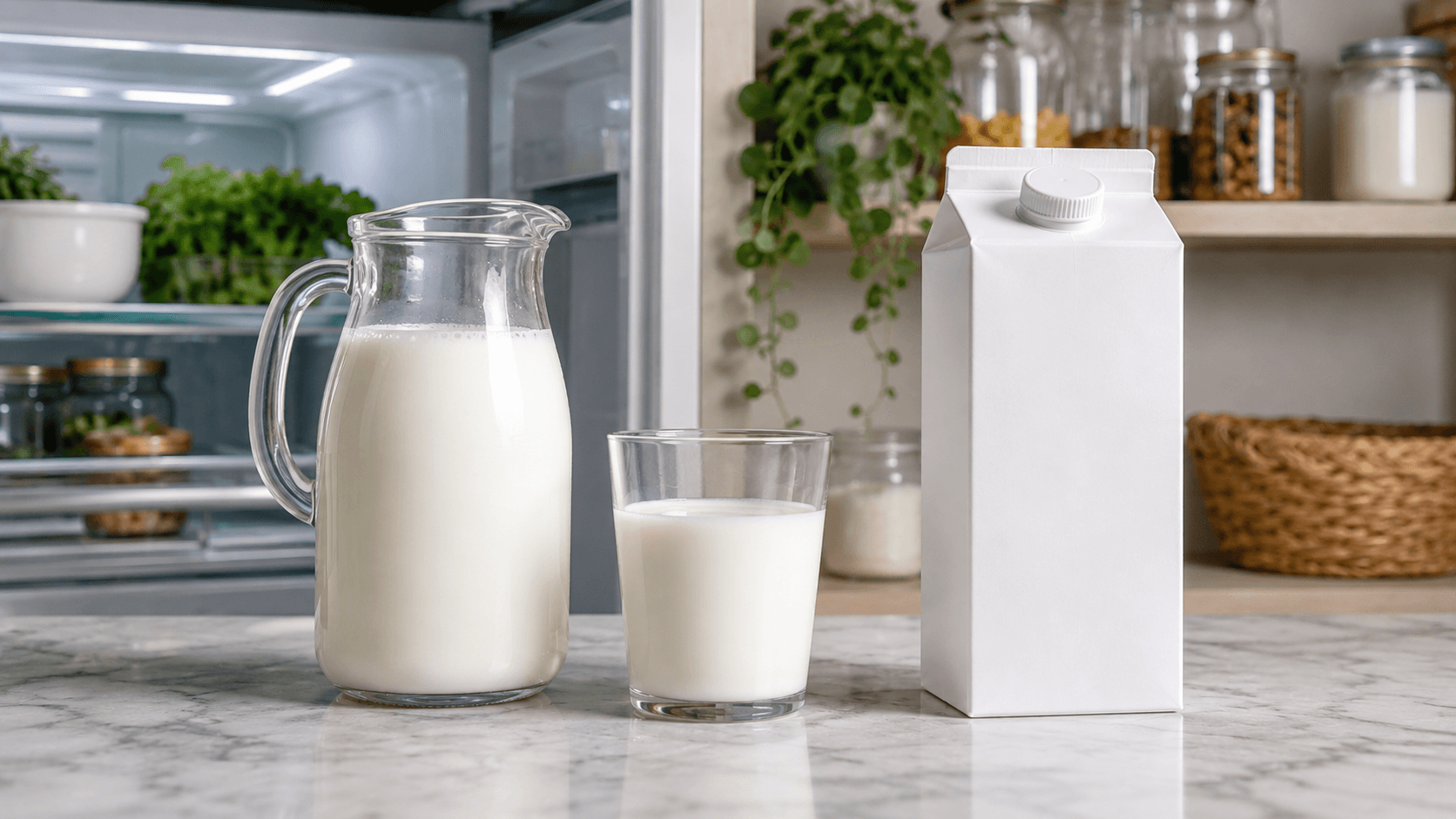
Fresh milk and UHT milk go through different processing and storage methods. Learn how they differ in taste, shelf life and everyday use, and where full cream and non-homogenised milk fit into the picture.
11 min readBy Kisaan
Walk into an Australian supermarket and you'll usually find milk in two very different parts of the store.
There is the familiar refrigerated section, filled with chilled milk in bottles and cartons. Then there is the long-life milk section, where UHT milk can sit on the shelf without refrigeration until it is opened.
Both are milk. Both can be used for drinking, coffee, cooking and everyday meals. So why are they processed differently, and what actually changes between fresh milk and UHT milk?
The answer comes down largely to how the milk is heat-treated, packaged and stored
.
Understanding that difference can make choosing milk much easier, especially if you're deciding between refrigerated fresh milk and long-life milk for your household.
What Is Fresh Milk?
In everyday Australian shopping, fresh milk generally refers to chilled pasteurised milk that is kept refrigerated from processing through to purchase and use.
Pasteurisation uses controlled heating to reduce harmful bacteria while retaining the milk's important characteristics. Dairy Australia describes conventional pasteurisation as heating milk to around 74°C for 15 seconds, followed by cooling.
Fresh milk then needs to remain refrigerated.
The word fresh doesn't mean the milk has not been processed. Pasteurisation is an important part of producing safe drinking milk in Australia.
So when you pick up a bottle of chilled milk from the refrigerator, you're generally buying milk that has been pasteurised and kept cold.
What Is UHT Milk?
UHT stands for Ultra-High Temperature or Ultra-Heat Treatment, depending on how it is described.
UHT milk is heated to a much higher temperature than conventionally pasteurised milk — around 140°C for two seconds according to Dairy Australia — and is then packaged aseptically. This process greatly extends its shelf life.
That's why UHT milk is commonly called long-life milk.
An unopened carton can be stored at room temperature according to the product's storage instructions, making it particularly convenient for keeping a supply of milk in the pantry.
Once opened, however, UHT milk needs to be refrigerated and handled like other opened milk products. Dairy Australia says UHT milk typically lasts around seven days after opening, although the product's own instructions should always be followed.
Fresh Milk vs UHT Milk: The Main Difference
The simplest way to understand the difference is to look at processing and storage.
Fresh Milk
UHT / Long-Life Milk
Typical processing
Conventional pasteurisation
Ultra-High Temperature treatment
Approx. heat treatment
Around 74°C for 15 seconds
Around 140°C for 2 seconds
Packaging
Refrigerated/chilled
Aseptically packaged
Unopened storage
Refrigerated
Can generally be stored at room temperature
After opening
Keep refrigerated
Keep refrigerated
Shelf life
Relatively short
Much longer
Taste
Familiar fresh/chilled milk character
Can have a slightly different cooked or UHT character
Main advantage
Fresh/chilled experience
Convenience and long storage
The exact processing parameters and shelf life can vary by product, so the information on the individual package should always take priority.
Why Does UHT Milk Last So Much Longer?
This is one of the biggest differences you'll notice when shopping.
A bottle of chilled milk has a relatively short shelf life and needs to remain refrigerated. UHT milk, on the other hand, can remain unopened in the pantry for months.
That's because UHT treatment uses a much higher temperature for a very short period and is followed by aseptic packaging. The combination greatly reduces microorganisms and helps prevent contamination after processing.
This doesn't mean preservatives have been added to make the milk last longer.
Dairy Australia states that fresh white milk, whether chilled or UHT, has nothing added that isn't already naturally part of milk.
The long shelf life comes from processing and packaging.
Does UHT Milk Need to Be Refrigerated?
Not while it is unopened, provided it is stored according to the product's instructions.
That's one of the biggest practical advantages of long-life milk.
You can keep unopened UHT milk in a suitable pantry or cupboard without taking up valuable refrigerator space.
Once you open it, the situation changes.
Opened UHT milk needs to be refrigerated, and you should follow the storage and consumption instructions on the package. Dairy Australia gives seven days as a typical timeframe for opened UHT milk.
Does Fresh Milk Need to Be Refrigerated?
Yes.
Fresh chilled milk needs to stay refrigerated from the time you purchase it through to consumption.
This is why you find fresh milk in the refrigerated section of supermarkets and grocery stores.
Once you open a bottle, keeping it cold becomes even more important. Always follow the storage instructions and use-by date on the product.
Is UHT Milk as Nutritious as Fresh Milk?
This is one of the most common questions — and the answer is more straightforward than many people expect.
Dairy Australia says long-life/UHT milk provides the same essential nutrients found in fresh milk, including calcium, protein, potassium and vitamins A and B12. Some heat-sensitive nutrients can be slightly reduced during UHT treatment, but Dairy Australia describes these losses as minimal.
Calcium, in particular, is not significantly reduced by the UHT process.
So it isn't accurate to assume that UHT milk suddenly loses all of the nutritional value of milk because it has been heat-treated.
Both fresh and UHT milk can contribute important nutrients to the diet(Must read labels).
Does UHT Milk Taste Different From Fresh Milk?
This is where personal preference becomes important.
Some people find UHT milk has a slightly different flavour compared with chilled fresh milk. The higher heat treatment can create a subtle cooked or heated-milk character.
Others don't mind the difference at all, particularly when the milk is used in coffee, tea, cereal or cooking.
Fresh chilled milk tends to have the familiar flavour that many Australians associate with refrigerated milk.
Neither preference is wrong.
If you're someone who enjoys the taste of freshly chilled milk, you may naturally prefer fresh milk. If convenience and pantry storage matter more, UHT milk can be extremely practical.
Is Fresh Milk Better Than UHT Milk?
There's no simple answer to this because “better” depends on what you want from your milk.
If you want:
A chilled, fresh-milk experience
Milk kept in the refrigerator
A familiar fresh dairy taste
Shorter supply cycles
then fresh milk may suit you better.
If you want:
Long shelf life
Pantry storage
Milk available without regular supermarket trips
A convenient backup supply
Less dependence on refrigerator space
then UHT milk may be more practical.
The choice doesn't have to be about one being superior.
It's about choosing the type that fits your household.
What About Full Cream Milk?
Here's another point that often causes confusion.
Fresh milk and UHT milk describe processing and storage. Full cream describes the milk's fat level.
That means full cream milk can exist in both categories.
You can have:
Fresh full cream milk
and
UHT full cream milk.
In fact, Australian retailers commonly sell full cream UHT milk.
So “full cream” doesn't automatically mean “fresh”, and “UHT” doesn't automatically mean “low fat”.
Homogenisation is different from pasteurisation and UHT treatment.
Homogenisation is a process used to distribute milk fat more evenly throughout the milk. When milk is not homogenised, the fat can naturally separate and cream can rise towards the top.
This is why you can have milk that is:
Fresh and homogenised
Fresh and non-homogenised
Full cream and homogenised
Full cream and non-homogenised
These terms describe different aspects of the milk.
For example, Kisaan's un-homogenised full cream milk is kept refrigerated and allows the natural cream to rise to the top.
Dairy Australia specifically notes that UHT milk can be used in coffee just like chilled milk.
The choice usually comes down to taste and convenience.
If you prefer the flavour of chilled fresh milk, use fresh milk.
If you keep UHT milk in the pantry for convenience, it can work well in your daily coffee too.
For milk-forward coffees such as flat whites and lattes, the milk itself becomes a noticeable part of the drink, so some people simply prefer the flavour of one type over another.
Which Milk Is Better for Chai?
Both can be used for chai.
Fresh full cream milk can provide the rich, familiar dairy character many people enjoy in traditional chai.
UHT milk can also be used, particularly when convenience and pantry storage are important.
If you're making chai regularly, the best choice is ultimately the one whose flavour and texture you enjoy.
Can You Cook With UHT Milk?
Yes.
UHT milk can be used in everyday cooking just like other milk, including recipes for:
Chai
Coffee
Desserts
Sauces
Baking
Porridge
Cereal
Other milk-based recipes
The heat treatment doesn't make it unsuitable for cooking.
Likewise, fresh milk can be used across the same kinds of recipes.
The main difference you'll notice may be in flavour, depending on the recipe and your preference.
Can You Make Dahi or Paneer With Fresh Milk?
Fresh milk is commonly used in traditional home preparation of dairy foods such as dahi and paneer.
The final result depends on the milk, recipe and technique used.
If you're specifically looking for a rich milk for traditional recipes, full cream milk is another characteristic worth considering separately from whether the milk is fresh or UHT.
If you're specifically looking for a rich milk for traditional recipes, buffalo milk is another option worth considering separately from whether the milk is fresh or UHT.
This is why understanding the different labels on a bottle can be useful.
Fresh Milk, Long-Life Milk and the Buying Decision
When choosing milk, it can help to ask three simple questions.
1. How often do you buy milk?
If you shop frequently and already have refrigerator space available, fresh milk can fit easily into your routine.
If you prefer buying several cartons at once, long-life milk can be more convenient.
2. How do you use milk?
If milk is mainly used for drinking, coffee or breakfast, taste may be your biggest consideration.
If you use it occasionally, UHT milk can be useful because an unopened carton can stay in the pantry until needed.
3. What kind of milk do you prefer?
Do you want full cream or reduced fat?
Do you prefer homogenised milk or natural cream-on-top milk?
Do you prefer fresh chilled milk or long-life milk?
These are separate questions — and understanding them makes choosing milk much easier.
Where Does Kisaan Fit In?
Kisaan focuses on fresh dairy products, including refrigerated milk sourced from Australian dairy farms.
Our milk range includes Pasteurized Un-Homogenized Full Cream Milk, which offers a very different experience from shelf-stable UHT milk.
Because it is un-homogenised, the natural cream can rise to the top. And because it is fresh chilled milk, it belongs in the refrigerator rather than the pantry.
For people who enjoy the familiar experience of refrigerated milk with cream naturally rising to the top, this is an important part of what makes Kisaan's milk different. For families looking for fresh milk delivery in Australia, Kisaan offers a convenient way to enjoy fresh dairy at home, with home delivery available across Melbourne
Fresh milk offers the familiar refrigerated milk experience and a taste that many people prefer.
UHT milk offers convenience, a long unopened shelf life and the ability to keep milk in the pantry until it is needed.
Both undergo carefully controlled processing, and both can provide the essential nutrients naturally found in milk.
The right choice is the one that fits your taste, routine, storage space and household needs.
And if what you're looking for is fresh refrigerated milk with a traditional cream-on-top experience, that's where un-homogenised fresh milk becomes a particularly interesting option.
Frequently asked questions
Is fresh milk the same as UHT milk?
No. Both are milk, but they undergo different heat treatments. Fresh chilled milk is conventionally pasteurised, while UHT milk is heated to a much higher temperature for a very short time and aseptically packaged for a longer shelf life.
Is long-life milk the same as UHT milk?
Yes. UHT milk and long-life milk are commonly used terms for milk that has undergone ultra-high-temperature treatment and is packaged to remain shelf-stable while unopened.
Is UHT milk less nutritious than fresh milk?
UHT milk retains the essential nutrients found in fresh milk. Some heat-sensitive vitamins can be slightly reduced during processing, but Dairy Australia describes the overall nutrient differences as minimal.
Does UHT milk need to be refrigerated?
Unopened UHT milk generally does not need refrigeration when stored according to the product's instructions. Once opened, it should be refrigerated.
Why does UHT milk last longer?
UHT milk is heated to around 140°C for two seconds and then aseptically packaged. This greatly reduces microorganisms and allows the unopened product to have a much longer shelf life.
Does fresh milk have preservatives?
Plain fresh milk does not need added preservatives to extend its shelf life. Pasteurisation and refrigeration are used as part of its safe handling and storage.
Is full cream milk the same as fresh milk?
No. Full cream describes the milk's fat content, while fresh describes the chilled milk category and its processing/storage context. Full cream milk can also be produced as UHT milk.
Can UHT milk be full cream?
Yes. UHT milk is available in full cream and other fat levels.
Does fresh milk always have cream on top?
No. Cream rising to the top is associated with un-homogenised milk, not simply with the fact that milk is fresh. Homogenisation distributes the milk fat more evenly.
Is Kisaan milk fresh or UHT?
Kisaan's Pasteurized Un-Homogenized Full Cream Milk is a fresh refrigerated milk, rather than shelf-stable UHT milk. Its un-homogenised nature allows the natural cream to rise to the top.