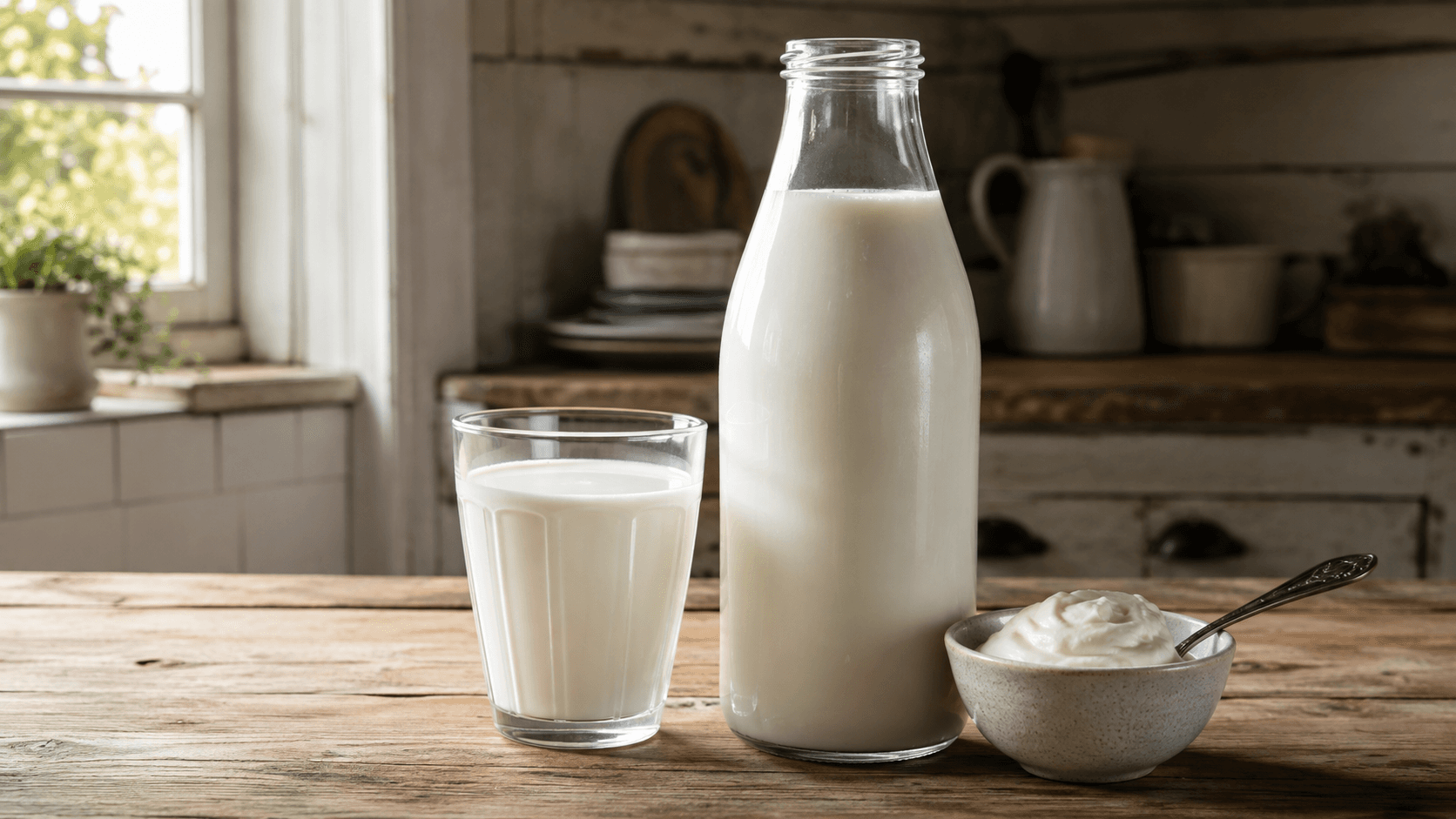
What Is Full Cream Milk? Benefits, Cream & Everyday Uses
Fresh Dairy
What Is Full Cream Milk? A Complete Guide to Taste, Cream and Everyday Use
Discover what full cream milk is, how it differs from low-fat and non-homogenised milk, why cream may rise to the top, and the many ways to enjoy it every day.
8 min readBy Kisaan
When buying milk, full cream is one of the most familiar descriptions on Australian supermarket shelves. But despite the name being widely recognised, many people still have questions about what it actually means.
Does full cream milk always have cream floating on top? Is it the same as whole milk? Is full cream milk always richer in taste? And can full cream milk be homogenised?
The answer to some of these questions depends on how the milk has been processed.
That distinction matters because
full cream
and
non-homogenised
do not mean the same thing. One describes the milk's fat content and the other describes a processing step. A bottle of milk can be full cream and homogenised, or full cream and un-homogenised.
At Kisaan, our range includes full cream milk for households looking for a richer dairy experience, including our Pasteurized Un-Homogenized Full Cream Milk with its familiar cream-on-top character.
This guide explains what full cream milk is, how it differs from other types of milk and what to look for when choosing the right milk for your home.
What Is Full Cream Milk?
Full cream milk is milk that retains its natural milk fat rather than having much of that fat removed to create lower-fat or skim varieties.
This gives it a fuller body and richer mouthfeel than reduced-fat milk.
Depending on the product, the exact fat level can vary. The best way to know the precise amount in a particular bottle is to check its nutrition panel. For example, Kisaan's Pasteurized Un-Homogenized Full Cream Milk currently lists 4.1g of fat per 100mL.
The important point is that full cream describes the type of milk, not whether the milk has been homogenised.
That is where many of the common questions begin.
Is Full Cream Milk the Same as Whole Milk?
In many conversations, full cream milk and whole milk are used to describe broadly similar types of milk: milk with its natural fat retained rather than significantly reduced.
However, product terminology can vary between countries and brands.
In Australia, shoppers are more likely to see full cream milk on the label, while whole milk is a term commonly used in other markets.
Rather than relying on the name alone, check the product label and nutrition information if you want to compare specific products.
Does Full Cream Milk Always Have Cream on Top?
No.
This is one of the most important differences to understand.
A milk can be full cream and still look completely uniform.
That usually comes down to homogenisation.
Full Cream Homogenised Milk
When full cream milk is homogenised, its milk fat is broken into much smaller particles and distributed more evenly through the liquid.
The result is milk that looks smooth and consistent from the top of the bottle to the bottom.
It can still be full cream milk.
Full Cream Un-Homogenised Milk
When full cream milk is not homogenised, its natural fat structure remains more intact.
Over time, the cream can naturally rise towards the top, creating the familiar cream layer associated with traditional cream-on-top milk.
This is the experience Kisaan's Pasteurized Un-Homogenized Full Cream Milk is designed to offer. The 2L and 5L products are both sold as un-homogenised full cream milk, allowing the natural cream to rise.
So, full cream milk does not automatically mean cream on top.
For that visible cream layer, you also need to consider whether the milk is homogenised.
For a detailed explanation, read our guide to Homogenised vs Un-Homogenised Milk.
Why Does Full Cream Milk Taste Richer?
Milk fat plays an important role in how milk feels and tastes.
Compared with lower-fat milk, full cream milk generally has a fuller mouthfeel and a richer dairy character. That is why many people enjoy it in situations where milk is a noticeable part of the final dish.
For example:
Morning chai
Coffee and flat whites
Cereal
Porridge
Smoothies
Homemade dahi
Paneer
Kheer and other desserts
Everyday cooking
Of course, personal preference matters. Some households prefer the lighter feel of reduced-fat milk, while others enjoy the fuller body of full cream milk.
There isn't one correct choice for every kitchen.
Full Cream Milk vs Low-Fat Milk
The main difference is the amount of milk fat retained in the final product.
Feature
Full Cream Milk
Low-Fat Milk
Milk fat
More retained
Partially reduced
Mouthfeel
Fuller and creamier
Lighter
Dairy flavour
Richer
Milder
Everyday uses
Drinking, cooking and recipes
Drinking, cereal and lighter everyday use
Cream on top
Possible if un-homogenised
Depends on processing and product
The best choice depends on what you enjoy and how you plan to use the milk.
If you are choosing milk for a particular dietary or medical reason, follow advice from an appropriately qualified health professional.
Full Cream Milk vs Non-Homogenised Milk
These terms are often confused, but they answer two completely different questions.
Full cream: How much of the milk's natural fat is retained?
Non-homogenised: Has the milk been mechanically homogenised to distribute its fat evenly?
This means a bottle can be:
Full cream and homogenised
Full cream and un-homogenised
Kisaan's cream-on-top milk is an example of the second category: full cream and un-homogenised.
That combination gives the milk its rich character while allowing the cream to rise naturally over time.
If you want to understand this in more detail, read our complete guide: What Is Non-Homogenised Milk in Australia?
Why Does Cream Rise to the Top?
In un-homogenised milk, the milk fat naturally separates over time and rises towards the surface.
This creates the familiar cream layer many people remember from traditional milk.
The cream can be gently mixed back into the milk by shaking the bottle before pouring. Some people also prefer to use the cream separately.
Kisaan's Old School Milk, Cream on the Top approach is built around this familiar experience: milk that is kept un-homogenised so the natural cream can rise.
For people who enjoy a rich and full-bodied chai, full cream milk is a popular choice.
The fuller dairy character works particularly well when milk is simmered with tea and spices such as ginger, cardamom or cloves.
Some households also prefer un-homogenised full cream milk for traditional chai because of its richer cream-on-top character.
Ultimately, the best milk for chai comes down to the style of tea you enjoy.
If you prefer a lighter cup, another milk may suit you better. If you enjoy a fuller, creamier chai, full cream milk can be a good choice.
Can You Use Full Cream Milk for Dahi and Paneer?
Yes, full cream milk is commonly used in home cooking and traditional dairy recipes.
Many people choose it when making:
Homemade Dahi
The fuller milk character can suit people looking for a richer homemade dahi.
Paneer
Milk composition plays an important role in homemade paneer. Full cream milk is commonly chosen when people want a richer final result.
Desserts
Recipes such as kheer and other milk-based desserts often benefit from milk with a fuller body and dairy flavour.
Results can vary depending on the recipe, technique and specific milk being used.
For households looking for a particularly rich milk for these recipes, buffalo milk is another option. Kisaan's buffalo milk guide explains its naturally higher milk solids and creamier character.
Can Full Cream Milk Be Used for Coffee?
Yes.
Full cream milk is widely used for coffee because its richer body creates a creamy drinking experience.
However, coffee performance can also depend on factors beyond whether the milk is full cream, including freshness, processing and steaming technique.
If you enjoy milk-forward coffees such as lattes or flat whites, experimenting with different full cream milk styles can help you find the texture you prefer.
How Should You Store Full Cream Milk?
Always follow the storage instructions on the specific product.
For un-homogenised milk, seeing cream rise to the top is normal.
If you prefer the cream mixed evenly through the milk, gently shake the bottle before pouring.
Keep milk refrigerated and consume it according to the product's storage and best-before guidance.
Choosing Full Cream Milk for Your Household
When choosing full cream milk, consider a few simple questions:
Do You Want Cream on Top?
If yes, look for un-homogenised full cream milk.
Do You Prefer a Smooth, Uniform Pour?
A homogenised full cream milk may better suit your routine.
What Do You Use Milk For?
Consider whether you mainly use milk for:
Everyday drinking
Children's breakfasts
Chai
Coffee
Dahi
Paneer
Desserts
Cooking
Different households value different things.
Check the Label
The product name tells part of the story, but the nutrition panel and processing information help explain what you are buying.
Kisaan Full Cream Milk
At Kisaan, we offer Pasteurized Un-Homogenized Full Cream Milk for households looking for the traditional experience of rich milk with natural cream rising to the top.
Our 2L , 5L, and 10L options are sourced from Victoria's Goulburn Valley and skip the homogenisation process, allowing the natural fat structure to remain intact and the cream to rise over time.
Whether you enjoy it as a glass of milk, shake the cream back through before pouring, or use it in your favourite chai and home cooking, it offers a cream-on-top dairy experience that connects naturally with our Old School Milk philosophy.
Frequently asked questions
What is full cream milk?
Full cream milk is milk that retains more of its natural milk fat than reduced-fat or skim milk, giving it a fuller body and creamier mouthfeel.
Is full cream milk the same as whole milk?
The terms are often used for broadly similar types of milk, although terminology can vary by market and product. In Australia, full cream milk is the more common label.
Does full cream milk always have cream on top?
No. Full cream milk can be homogenised or un-homogenised. Cream is more likely to visibly rise to the top when full cream milk is un-homogenised.
What is the difference between full cream and non-homogenised milk?
Full cream refers to the milk's retained fat, while non-homogenised refers to how the milk has been processed. A milk can be both full cream and non-homogenised.
Why does cream rise to the top of milk?
In un-homogenised milk, the fat naturally separates and rises over time, creating a cream layer.
Is full cream milk good for chai?
Many people enjoy full cream milk for chai because of its fuller body and richer dairy character.
Can I use full cream milk for paneer?
Yes. Full cream milk is commonly used for homemade paneer and other dairy-based recipes.
Does Kisaan sell full cream milk?
Yes. Kisaan sells Pasteurized Un-Homogenized Full Cream Milk in 2L, 5L and 10L formats, designed to provide a traditional cream-on-top experience.