What Is Cow Makhan? Traditional Cow Milk Makhan Guide
Fresh Dairy
What Is Cow Makhan? A Complete Guide to Traditional Cow Milk Makhan
Discover what Cow Makhan is, how traditional cow milk Makhan is made, why it has a naturally pale-yellow colour, how it differs from Buffalo Makhan, and how Kisaan brings traditional-style Cow Makhan to Australia.
8 min readBy Kisaan
If you have grown up in an Indian household or have been around traditional Indian food culture, the word Makhan is likely familiar to you. It brings to mind soft, creamy butter that is freshly churned, often enjoyed with warm roti, paratha, or even eaten on its own with a pinch of sugar or salt. It is simple, nostalgic, and deeply rooted in traditional dairy practices.
But in today’s modern world, where dairy products come in many forms and names, a common question arises: What exactly is Cow Makhan? And how is it different from the white Makhan or Buffalo Makhan that many people are used to seeing?
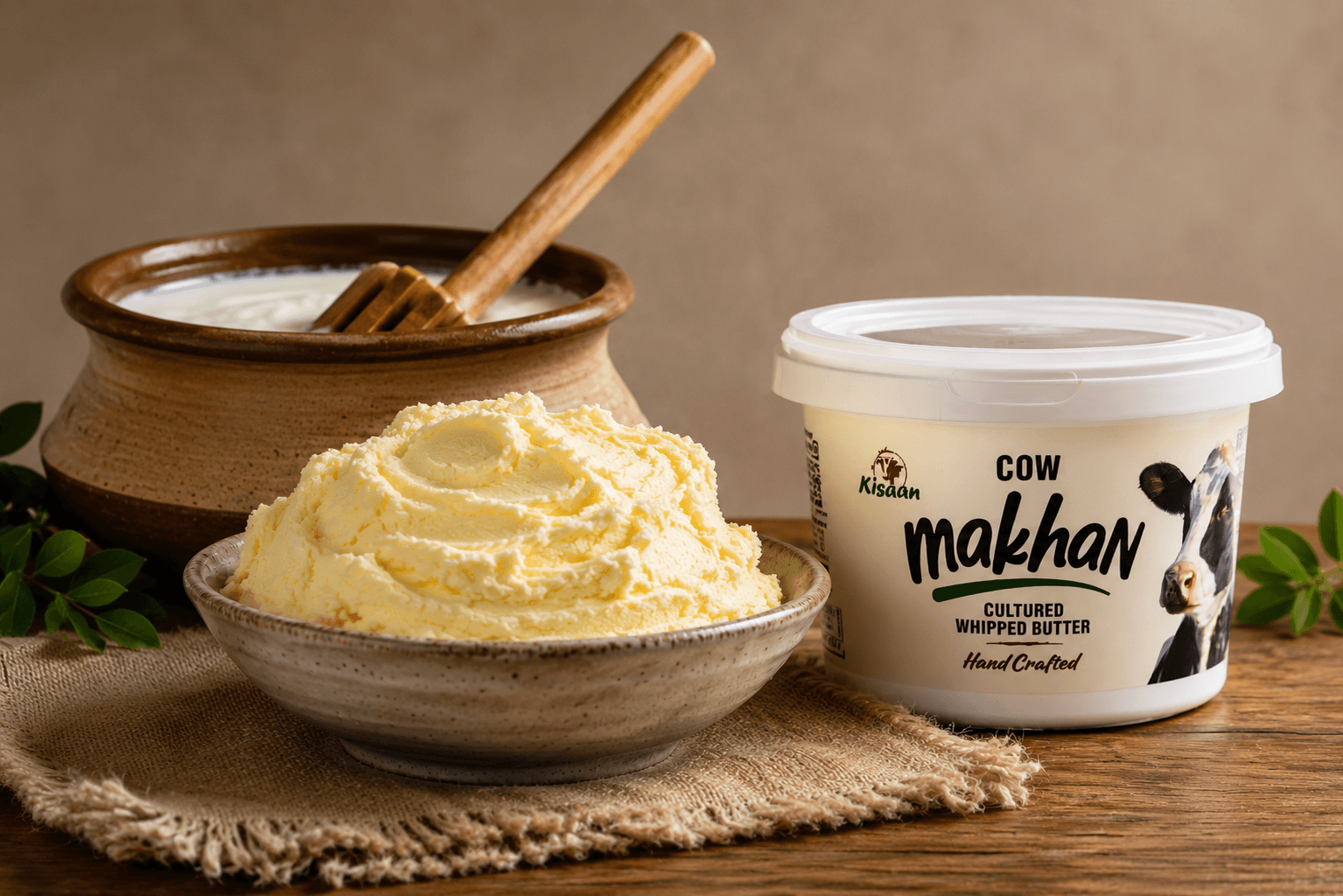
Cow Makhan is a traditional-style butter made from cow milk or cow milk cream, often prepared using cultured dairy and a churning process that separates butter from buttermilk. It is soft, creamy, and naturally light in colour, often appearing pale yellow rather than pure white.
Today, this traditional dairy product is no longer limited to rural kitchens. It is now available in modern packaged form as well, including products like Kisaan Cow Makhan in Australia, which allows people to enjoy the same traditional taste in a convenient, ready-to-use form.
In this detailed guide, we will explore everything about Cow Makhan—its origin, preparation, taste, differences from Buffalo Makhan, nutritional character, and how it fits into modern lifestyles.
Understanding What Cow Makhan Really Is
Cow Makhan is essentially butter made from cow’s milk, but its identity goes beyond just being a dairy spread. Traditionally, it is made by first turning milk into curd (dahi), and then churning it to extract butter.
In many Indian homes, this process was part of daily life. Fresh milk would be boiled, set into curd, and then churned using a traditional wooden churner known as a mathani. As the curd was churned, butter would gradually separate and float on top. This butter is what we call Makhan.
Unlike modern industrial butter, which is often made directly from cream using high-speed processing, traditional Makhan is closely linked to fermentation and hand-churning methods. This gives it a unique texture and flavour that many people still prefer today.
Cow Makhan, specifically, is made from cow milk, which naturally produces a lighter, softer butter compared to buffalo milk.
Why Cow Makhan Looks Different From White Makhan
One of the most common confusions people have is about the colour of Makhan. Many assume that Makhan should always be white. However, this is not entirely accurate.
Cow Makhan usually has a pale yellow or creamy yellow shade, while Buffalo Makhan is much whiter in appearance. This difference is completely natural and comes from the composition of the milk itself.
Cow milk contains natural pigments called carotenoids, which give the butter a slight yellow tint. Buffalo milk, on the other hand, has very low levels of these pigments, which is why its butter appears white.
So, if Cow Makhan looks slightly yellow, it is not a sign of artificial colouring or poor quality. In fact, it is a natural characteristic of cow milk fat.
Cow Makhan vs Buffalo Makhan: Key Differences
Although both are forms of traditional Indian butter, Cow Makhan and Buffalo Makhan differ in several important ways.
Feature
Cow Makhan
Buffalo Makhan
Milk Source
Cow milk
Buffalo milk
Colour
Pale yellow or creamy
Pure white
Texture
Soft and light
Dense and rich
Taste
Mild and delicate
Strong and creamy
Fat Content
Slightly lower
Higher
Traditional Use
Everyday meals, light consumption
Rich dishes, festive use
Cow Makhan is often preferred for its lightness and easy digestibility, while Buffalo Makhan is known for its richness and heavier texture.
Neither is better than the other—it simply depends on personal preference and dietary needs.
How Traditional Cow Makhan Is Made
The traditional process of making Cow Makhan is simple but deeply rooted in Indian food culture. It involves natural fermentation and physical churning rather than industrial processing.
Here is how it is traditionally prepared:
Boiling the milk Fresh cow milk is boiled to ensure purity and safety.
Setting curd (dahi) The boiled milk is cooled and mixed with a small amount of curd to ferment overnight.
Churning the curd The set curd is churned using a mathani or modern churner.
Separation of butter As churning continues, butter particles separate and float on top.
Collecting Makhan The floating butter is collected and gently shaped into soft Makhan.
This process not only produces butter but also results in buttermilk as a by-product, which is also widely consumed in Indian households.
Even today, many people believe that traditionally churned Makhan has a fresher and more natural taste compared to factory-made butter.
What Does Cow Makhan Taste Like?
Cow Makhan has a mild, creamy, and slightly sweet dairy flavour. It is not overpowering, which makes it suitable for both sweet and savoury dishes.
Because it is often made from cultured curd, it may also carry a slight tanginess depending on fermentation. This gives it a more complex flavour compared to regular butter.
The texture is soft and smooth, allowing it to melt easily on warm food like roti or paratha. Many people also enjoy it fresh, without cooking, because of its light and natural taste.
Why Cow Makhan Is Sometimes Yellow
The yellowish tone of Cow Makhan often surprises people who expect butter to be white. However, this colour is completely natural.
The main reason is the presence of beta-carotene, a natural compound found in cow milk fat. This compound is responsible for the pale yellow colour in butter.
Season, animal diet, and milk quality can also influence the shade. For example, cows that graze on fresh green grass may produce milk with slightly higher carotene levels, resulting in deeper yellow butter.
Buffalo milk contains much less carotene, which is why Buffalo Makhan appears white.
Is Cow Makhan the Same as Regular Butter?
Cow Makhan and regular commercial butter are not exactly the same, even though they are both butter products.
The key difference lies in how they are made:
Traditional Cow Makhan is made from cultured curd and churned manually or semi-manually.
Commercial butter is usually made by directly churning cream in industrial machines.
Because of this difference, Cow Makhan often has:
A fresher dairy taste
A softer texture
A more natural aroma
A slightly cultured flavour profile
Regular butter, on the other hand, is more uniform and neutral in taste.
Introduction to Kisaan Cow Makhan
In modern times, traditional dairy products have been adapted for convenience without losing their essence. One such example is Kisaan Cow Makhan, which brings traditional-style butter into a packaged, ready-to-use form.
Kisaan Cow Makhan is made using fresh cultured cream sourced from Australian dairy farms, particularly from the Goulburn Valley region. It is produced in small batches to maintain quality and consistency.
The product is unsalted, soft, and whipped, making it easy to spread and use in everyday meals.
This allows consumers in Australia to enjoy a traditional Indian dairy experience without the time-consuming process of home churning.
What Makes Kisaan Cow Makhan Special?
Kisaan Cow Makhan stands out because it combines traditional inspiration with modern dairy standards.
Some of its key features include:
Made from fresh cultured cream
Produced in Australia
Soft and whipped texture
Unsalted formulation
No artificial preservatives
Convenient 380g packaging
Suitable for everyday use
It is designed for people who want the taste of traditional Makhan but in a modern, hygienic, and easy-to-store format.
How You Can Use Cow Makhan in Daily Life
Cow Makhan is extremely versatile and can be used in many ways:
Spread on warm roti or paratha
Served with toast or bread
Added to dal or rice for extra richness
Used in traditional Indian meals
Melted over hot vegetables
Enjoyed fresh with sugar or jaggery
Many people also enjoy it simply as it is, appreciating its natural dairy flavour.
Cow Makhan vs Buffalo Makhan: Which One Should You Choose?
Choosing between Cow Makhan and Buffalo Makhan depends entirely on your taste preference.
Choose Cow Makhan if you prefer:
Light and soft texture
Mild dairy flavour
Pale yellow appearance
Easy digestibility
Choose Buffalo Makhan if you prefer:
Rich and heavy texture
Strong creamy taste
White appearance
High-fat content
Both are traditional and authentic in their own way.
Where to Buy Cow Makhan in Australia
Cow Makhan is now available in Australia through specialty dairy brands like Kisaan. You can find Kisaan Cow Makhan 380g through their official online store and selected grocery outlets.
Availability may vary depending on location, but Indian grocery stores and specialty dairy sections often stock traditional-style butter products.
For customers in cities like Melbourne, online ordering is often the easiest way to access fresh stock.
Final Thoughts
Cow Makhan is more than just butter—it is a reflection of traditional Indian dairy culture. From its simple preparation process to its soft texture and natural flavour, it carries a sense of authenticity that modern processed butter often lacks.
Whether you enjoy it for its taste, its cultural value, or its nutritional simplicity, Cow Makhan continues to remain a beloved part of Indian food traditions.
With products like Kisaan Cow Makhan, this traditional dairy experience is now easily accessible even outside India, allowing people in Australia to reconnect with familiar flavours in a modern and convenient way.
Cow Makhan is traditional-style butter made from cow milk or cow milk cream. Traditionally, milk was cultured into dahi and then churned to separate the soft butter, known as Makhan.
Is Cow Makhan naturally yellow?
Yes. Cow Makhan can naturally have a pale yellow or creamy-yellow colour. Natural pigments such as carotenoids in cow milk fat contribute to this colour.
Why is Cow Makhan yellow while Buffalo Makhan is white?
Cow milk naturally contains more carotenoid pigments, which can give its butter a pale-yellow colour. Buffalo milk contains much less of these pigments, so Buffalo Makhan is naturally much whiter.
Is Kisaan Cow Makhan made from cultured cream?
Yes. Kisaan Cow Makhan is made using fresh cultured cream and is produced as a soft, whipped, unsalted butter.
Is Kisaan Cow Makhan unsalted?
Yes. Kisaan Cow Makhan is an unsalted cultured whipped butter, making it suitable for enjoying on its own or using in everyday meals and recipes.
What does Kisaan Cow Makhan taste like?
Kisaan Cow Makhan has a creamy, mild dairy flavour and soft whipped texture. Its cultured cream base gives it a distinctive traditional-style butter character.
What is the difference between Cow Makhan and Buffalo Makhan?
Cow Makhan is made from cow milk or cow milk cream and typically has a naturally pale-yellow appearance. Buffalo Makhan is made from buffalo milk and is naturally much whiter. Kisaan offers both varieties so customers can choose according to their taste and preference.
Is Cow Makhan the same as regular butter?
Cow Makhan is a type of butter, but traditional-style Cow Makhan is associated with cultured dairy and the traditional churning process. Kisaan Cow Makhan is made using fresh cultured cream and has a soft, whipped texture.
How can I use Cow Makhan?
Cow Makhan can be enjoyed with roti, paratha, bread or toast, or added to everyday Indian meals. Its soft texture also makes it convenient for spreading and cooking.
Where can I buy Kisaan Cow Makhan in Australia?
You can buy Kisaan Cow Makhan 380g through the Kisaan online store. Kisaan products are also available through selected grocery stores, depending on location and current stock.
Can I buy Kisaan Cow Makhan in Melbourne?
Yes. Kisaan Cow Makhan is available for customers in Melbourne through Kisaan's online store, and Kisaan products are also available through selected grocery stores in the area.
What size is Kisaan Cow Makhan available in?
Kisaan Cow Makhan is available in a 380g tub, providing a convenient format for home use and refrigeration.