What Is White Makhan? Buffalo Makhan & White Butter in Austr
Fresh Dairy
What Is White Makhan? Buffalo Makhan, White Butter & Traditional Makhan in Australia
Discover what White Makhan is, why Buffalo Makhan has a naturally marble-white colour, how it differs from Cow Makhan, and how traditional Makhan is enjoyed in Indian cooking across Australia.
14 min readBy Kisaan
For many Indian families, Makhan needs little introduction.
It is the soft, creamy butter traditionally enjoyed with hot parathas, naan and rotis, or used alongside familiar dishes such as Dal Makhani, paneer dishes and curries. For others discovering traditional Indian dairy in Australia, however, the names can be confusing.
What is White Makhan?
Is White Makhan simply another name for butter?
Why is Buffalo Makhan white?
Why can Cow Makhan have a pale yellowish colour?
And what makes traditional Makhan different from the butter commonly found in Australian supermarkets?
The answers begin with something very simple: the milk used to make it.
Buffalo and cow dairy have naturally different characteristics, and those differences can be seen in the colour, texture and flavour of the finished Makhan.
In this guide, we'll look at White Makhan, Buffalo Makhan and Cow Makhan, how they are made, how they differ and how Makhan fits into traditional cooking for families across Australia.
If you're new to Makhan altogether, you can first explore Kisaan's broader guide to Makhan in Australia.
What Is Makhan?
Makhan is the traditional Indian name commonly used for butter.
The word has been part of Indian food culture for generations and is closely associated with fresh, soft butter made from dairy and enjoyed as part of everyday meals.
Unlike the word "butter", which covers a very broad commercial category, Makhan often brings to mind a particular style of dairy preparation and a particular way of eating it.
Think of:
Hot parathas with a spoonful of Makhan
Fresh naan with soft butter
Roti served with Makhan
Traditional paneer dishes
Dal Makhani
Curries and home-style meals
Makhan can be made using different types of milk, which means its appearance and characteristics don't have to be identical from one variety to another.
This is where Buffalo Makhan and Cow Makhan become important.
What Is White Makhan?
White Makhan is the traditional white butter associated with Buffalo Makhan.
The name makes more sense when you consider the natural characteristics of buffalo dairy.
Buffalo milk has a naturally white appearance and contains considerably less carotenoid pigment than cow milk. Cow milk fat can have more yellow or golden tones because of naturally occurring pigments.
That difference can carry through into the butter made from the respective milk.
As a result, butter made from buffalo dairy is naturally much paler and is traditionally associated with terms such as White Makhan and White Butter.
Kisaan Buffalo Makhan reflects this character with its distinct marble white colour.
So when Australians search for White Makhan Australia, White Butter Australia or Buffalo Makhan Australia, these terms can point towards the same traditional style of dairy product.
Why Is Buffalo Makhan Marble White?
The answer isn't complicated, but it is interesting.
The colour begins with the milk.
Buffalo milk contains very little carotenoid pigment compared with cow milk. Carotenoids are among the natural pigments that can contribute to the creamy or yellowish colour associated with cow-milk fat.
With much less of this pigment in buffalo milk, the resulting dairy fat is naturally much paler.
That characteristic can be seen in butter made from buffalo dairy.
This is why Buffalo Makhan has such a strong connection with White Makhan.
It isn't necessary to add colour simply to create the traditional appearance.
Kisaan Buffalo Makhan is made using Australian buffalo cultured cream, and its natural product description identifies its colour as distinct marble white.
Does White Makhan Have Added Colour?
No colourant is used in Kisaan's Buffalo Makhan.
The product is made from Australian buffalo cultured cream and is described as natural and free from preservative, colourant and artificial flavour.
That distinction is worth understanding.
A product can have a distinctive colour without that colour being artificially created.
In the case of Buffalo Makhan, the naturally white character of buffalo dairy helps explain its appearance.
So the marble-white colour is part of what makes Buffalo Makhan recognisable as White Makhan.
What Is Buffalo Makhan?
Buffalo Makhan is Makhan made using buffalo cultured cream.
Kisaan Buffalo Makhan is specially handcrafted by slow churning Australian buffalo cultured cream with a mild whipping process.
The finished Makhan has:
A distinct marble white colour
A distinct flavour profile
A creamy texture
A smooth texture
A soft texture
It is also natural and free from:
Preservatives
Colourant
Artificial flavour
The product is designed to fit naturally into traditional Indian meals, whether you're spreading it over hot paratha, serving it with naan or roti, or enjoying it with traditional dishes.
Kisaan's live product information also describes its Buffalo Makhan as artisanal white butter made from fresh cultured cream sourced from dedicated Goulburn Valley farmers.
What Makes Buffalo Makhan Different From Regular Butter?
At a basic level, Buffalo Makhan is butter.
The difference is in the milk source, preparation, characteristics and culinary tradition.
Regular commercial butter can be made for a wide range of everyday applications, including spreading, baking and general cooking.
Traditional Makhan has a much stronger cultural connection with Indian food and dairy preparation.
With Kisaan Buffalo Makhan, the product is made from Australian buffalo cultured cream and slowly churned with a mild whipping process.
The result is a product with its own:
Natural colour
Texture
Flavour
Dairy character
Culinary uses
So it isn't necessary to describe Makhan as something completely separate from butter.
It is more useful to understand Makhan as a traditional style of butter with its own identity.
What Is Cow Makhan?
Cow Makhan is another variety of traditional Makhan, made using cultured cream from cow milk.
Kisaan Cow Makhan is specially handcrafted through slow churning of cultured cream with a mild whipping process.
Its natural characteristics include:
Pale yellowish colour
Distinct flavour profile
Creamy texture
Soft texture
It is also natural and free from:
Preservatives
Colourant
Artificial flavour
The difference between Cow Makhan and Buffalo Makhan therefore begins with the milk source.
Both are Makhan.
Both use cultured cream.
Both are slowly churned with a mild whipping process.
But the finished products naturally have different characteristics.
Why Is Cow Makhan Pale Yellowish?
This is where the difference between cow and buffalo dairy becomes particularly visible.
Cow milk naturally contains carotenoid pigments. These pigments can contribute to the creamy, yellow or golden appearance associated with cow-milk dairy fat.
That natural characteristic can be reflected in Cow Makhan.
Kisaan Cow Makhan has a pale yellowish colour as part of its natural appearance.
Importantly, the product contains no colourant or artificial flavour.
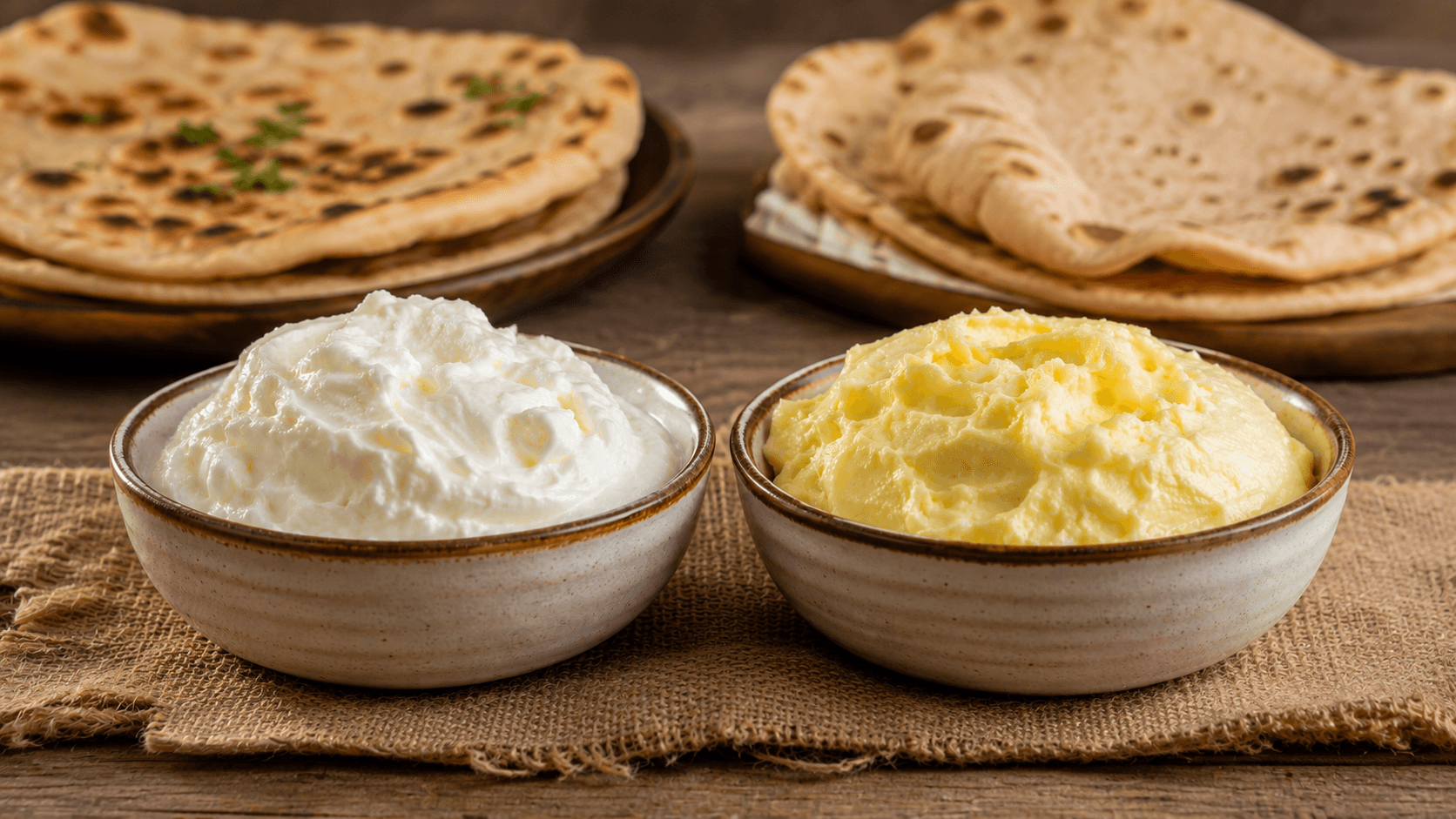
So if you compare the two varieties visually:
Buffalo Makhan → Marble white
Cow Makhan → Pale yellowish
The difference isn't about one product being artificially coloured.
It is a natural difference associated with the respective dairy source.
Buffalo Makhan vs Cow Makhan
If you're deciding between the two, the easiest place to start is the milk source.
Feature
Buffalo Makhan
Cow Makhan
Main dairy source
Australian buffalo cultured cream
Cow cultured cream
Traditional association
White Makhan / White Butter
Cow Makhan
Natural colour
Distinct marble white
Pale yellowish
Preparation
Slow churning + mild whipping
Slow churning + mild whipping
Texture
Creamy, smooth and soft
Creamy and soft
Flavour
Distinct flavour profile
Distinct flavour profile
Preservative
None
None
Colourant
None
None
Artificial flavour
None
None
This isn't a case of choosing a "good" product and a "bad" product.
They're two different Makhan varieties.
If you specifically want the traditional white butter associated with buffalo dairy, Buffalo Makhan is the natural choice.
If you prefer the naturally pale yellowish character of Cow Makhan, that gives you another traditional option.
How Is Kisaan Buffalo Makhan Made?
The process begins with Australian buffalo cultured cream.
Kisaan Buffalo Makhan is specially handcrafted by slowly churning the cultured cream, followed by a mild whipping process.
The purpose isn't simply to turn cream into a generic butter.
The process helps create the characteristic Makhan texture: creamy, smooth and soft.
The finished product also retains the distinct flavour profile and marble-white appearance associated with this Buffalo Makhan.
This combination of cultured cream, slow churning and mild whipping is central to the product's character.
How Is Kisaan Cow Makhan Made?
Cow Makhan follows the same broad idea of working with cultured cream, but uses cow dairy.
Kisaan Cow Makhan is specially handcrafted through slow churning of cultured cream with a mild whipping process.
This produces a soft and creamy Makhan with a distinct flavour profile and natural pale yellowish appearance.
The difference between the two products therefore isn't created by trying to make them look or taste the same.
Instead, their individual characteristics are allowed to come through.
What Does Cultured Cream Mean?
Cultured cream is cream that has undergone a culturing process before being used in the final dairy product.
It is an important part of both Kisaan Makhan varieties.
Rather than simply taking ordinary cream and turning it into butter, cultured cream forms the starting point for the Makhan-making process.
The cream is then slowly churned and gently whipped.
This helps create the familiar soft, creamy character associated with Makhan.
Why Is Churning Important in Makhan?
Churning is at the heart of butter-making.
Milk fat exists naturally in tiny globules within dairy. As cream is churned, those fat globules come together and form butter.
Traditional butter-making has relied on this basic principle for generations.
Modern producers can use controlled equipment and processes, but the underlying idea remains familiar:
Cream → churning → butter/Makhan
Kisaan's Makhan takes this basic dairy process and applies it to cultured cream, with slow churning and a mild whipping process.
How Is White Makhan Traditionally Enjoyed?
One of the best things about Makhan is that it doesn't need complicated preparation.
It works beautifully with foods already found in many Indian kitchens.
With Hot Parathas
A warm paratha topped with soft Makhan is one of the most familiar combinations.
The heat softens the Makhan, allowing it to melt naturally into the layers of the paratha.
With Naan
Makhan pairs naturally with hot naan and can be enjoyed as part of a simple meal.
With Roti
Fresh roti and Makhan make an easy traditional combination.
With Paneer Dishes
Makhan can also be enjoyed with dishes featuring paneer.
With Dal Makhani
Dal Makhani is one of the traditional dishes closely associated with rich dairy flavours, and Makhan can be enjoyed alongside it.
With Curries
Makhan can also accompany favourite curries and other home-style meals.
The idea is simple: good Makhan doesn't need an elaborate recipe to have a place at the table.
White Makhan vs Regular Butter
If you're familiar with Australian supermarket butter, you may wonder how White Makhan compares.
The broad category is still butter.
But there can be significant differences in:
Milk source
Culturing
Preparation
Texture
Flavour
Natural colour
Culinary tradition
Commercial butter is generally designed for consistency across everyday applications such as spreading, baking and cooking.
Makhan has a stronger traditional Indian identity.
It is particularly associated with foods such as paratha, roti, naan and traditional Indian dishes.
So rather than asking which one is universally better, it's more useful to ask:
Which type of butter suits the food and tradition you're looking for?
White Makhan vs Ghee
White Makhan and ghee are both important in Indian dairy culture, but they are not the same product.
White Makhan
Traditional butter/Makhan, particularly associated with the naturally white appearance of Buffalo Makhan.
Ghee
Clarified butter produced through heating and clarification.
Ghee has a different texture, flavour and cooking behaviour.
So if you're searching for White Makhan in Australia, don't assume ghee is an alternative name for the same product.
They're related dairy products, but they serve different purposes.
Why Does Natural Dairy Colour Matter?
Colour is one of the first things we notice when looking at food.
But with dairy products, natural colour can vary according to the milk source.
Both are natural products and both are free from colourant.
That makes the difference useful rather than confusing.
If you're specifically looking for White Makhan, the naturally marble-white Buffalo Makhan is the product that fits that description.
If you're looking for Cow Makhan, a pale yellowish appearance is part of its natural character.
What Should You Look for When Buying Makhan in Australia?
If you're searching for Makhan Australia, White Makhan Australia, White Butter Australia, Buffalo Makhan Australia or Cow Makhan Australia, consider more than just the product name.
1. Check the milk source
Are you looking for Buffalo Makhan or Cow Makhan?
This is the most important distinction between the two Kisaan varieties.
2. Look at the preparation
Check whether the product is made using cultured cream and how the cream is churned.
3. Understand the natural colour
Buffalo and cow dairy don't necessarily produce butter with the same colour.
4. Read the ingredient information
If you prefer natural dairy, look for transparent information about preservatives, colourants and artificial flavours.
5. Think about how you'll use it
Paratha, naan, roti, curries and traditional dishes can all influence which Makhan you prefer.
6. Check storage instructions
Makhan is a dairy product, so always follow the producer's refrigeration and storage instructions.
Australian Makhan With a Traditional Connection
Finding traditional Indian dairy in Australia doesn't necessarily mean choosing between tradition and local sourcing.
Kisaan works with local farmers in Victoria's Goulburn Valley and produces a range of dairy products from Australian cow and buffalo milk. Its broader range includes milk, ghee, yoghurt, curd, butter and Makhan.
The Buffalo Makhan product specifically uses Australian buffalo cultured cream, connecting the traditional Makhan concept with Australian dairy production.
For families who grew up eating Makhan, that can make a familiar food easier to enjoy in Australia.
For Australians discovering it for the first time, it offers a simple introduction to a traditional dairy product with a very different culinary identity from ordinary supermarket butter.
Where to Buy White Makhan in Australia
If you're searching for White Makhan, you may find different terminology depending on the retailer or producer.
Useful searches include:
White Makhan Australia
White Butter Australia
Buffalo Makhan Australia
Buffalo White Butter
Makhan Australia
Indian Makhan Australia
Kisaan currently lists both Buffalo Makhan 380g and Cow Makhan 380g in its Makhan range.
The Buffalo product is the relevant choice when you're specifically looking for the marble-white Buffalo Makhan associated with White Makhan.
Kisaan Buffalo Makhan
Kisaan Buffalo Makhan is made using Australian buffalo cultured cream and is specially handcrafted through slow churning with a mild whipping process.
Its defining characteristics include:
Distinct marble white colour
Distinct flavour profile
Creamy texture
Smooth texture
Soft texture
Natural formulation
No preservative
No colourant
No artificial flavour
The product is designed to be enjoyed with hot parathas, naan and rotis, as well as traditional dishes featuring paneer, Dal Makhani and curries.
Kisaan's live product page also highlights fresh cultured cream and Goulburn Valley sourcing.
For anyone looking specifically for White Makhan in Australia, Buffalo Makhan is the key product to explore.
Kisaan Cow Makhan
Kisaan Cow Makhan is made using cultured cream from cow milk, with the cream slowly churned and gently whipped.
Its natural characteristics include:
Pale yellowish colour
Distinct flavour profile
Creamy texture
Soft texture
Natural character
No preservative
No colourant
No artificial flavour
It is equally suited to traditional Indian food, including hot parathas, naan, rotis, paneer dishes, Dal Makhani and curries.
The difference from Buffalo Makhan is easy to see:
Buffalo Makhan → marble white
Cow Makhan → pale yellowish
Both are traditional Makhan.
Both are made from cultured cream.
Both have their own natural character.
Final Thoughts
White Makhan isn't simply about a white colour.
It represents a traditional style of butter closely connected with buffalo dairy and Indian food culture.
Buffalo Makhan has a distinct marble-white appearance, while Cow Makhan naturally has a pale yellowish appearance.
Both begin with cultured cream.
Both are slowly churned with a mild whipping process.
Both have a place in traditional Indian cooking.
But their different milk sources give them their own natural appearance, flavour and texture.
For someone searching for White Makhan in Australia, understanding that distinction makes choosing much easier.
If you're looking for the traditional marble-white Buffalo variety, explore Buffalo Makhan.
If you prefer the naturally pale yellowish character of Cow Makhan, that offers a different expression of the same traditional dairy staple.
Either way, Makhan remains what it has always been at its heart: simple, traditional butter made to be enjoyed with good food.
White Makhan is traditional white butter associated particularly with Buffalo Makhan. Kisaan Buffalo Makhan has a distinct marble-white colour.
Is White Makhan the same as butter?
White Makhan is a traditional form of butter. Makhan is commonly used in India to refer to butter, while White Makhan refers to the white butter tradition associated with buffalo dairy.
Is White Makhan the same as Buffalo Makhan?
White Makhan and Buffalo Makhan are closely associated because buffalo dairy naturally produces very pale butter. Kisaan Buffalo Makhan is specifically made using Australian buffalo cultured cream and has a marble-white colour.
Why is Buffalo Makhan white?
Buffalo milk contains considerably less carotenoid pigment than cow milk, contributing to the naturally white appearance of buffalo dairy fat and butter.
Does Buffalo Makhan have added colour?
Kisaan Buffalo Makhan is free from colourant. Its product description identifies its natural appearance as distinct marble white.
What is Cow Makhan?
Cow Makhan is traditional Makhan made using cultured cow cream. Kisaan Cow Makhan is slowly churned with a mild whipping process and has a naturally pale yellowish colour.
Why is Cow Makhan yellowish?
Cow milk naturally contains pigments that can contribute to yellow or golden tones in its milk fat. This can be reflected in Cow Makhan's natural colour.
What is the difference between Buffalo Makhan and Cow Makhan?
Buffalo Makhan is made from Australian buffalo cultured cream and has a distinct marble-white colour. Cow Makhan is made from cultured cow cream and has a pale yellowish colour. Both have creamy textures and are slowly churned with a mild whipping process.
Does Cow Makhan contain colour?
Kisaan Cow Makhan is free from colourant. Its pale yellowish appearance is part of its natural character.
Is White Makhan the same as ghee?
No. White Makhan is butter/Makhan, while ghee is clarified butter.
What can you eat with White Makhan?
White Makhan can be enjoyed with hot parathas, naan and rotis and alongside traditional Indian dishes.
Can Makhan be used with Dal Makhani?
Yes. Makhan pairs naturally with traditional dishes such as Dal Makhani, as well as paneer dishes and curries.
Where can I buy Buffalo Makhan in Australia?
Kisaan lists Buffalo Makhan as part of its Australian dairy range. Availability can change, so check the current product page before ordering.