Cow Makhan vs Buffalo Makhan: What's the Difference?
Buying Guides
Cow Makhan vs Buffalo Makhan: What's the Difference and Which One Should You Choose?
Cow Makhan and Buffalo Makhan have different natural colours, textures and flavour profiles. Learn how they differ, why Buffalo Makhan is traditionally white, and which Makhan is right for you in Australia.
15 min readBy Kisaan
When you start looking for traditional Makhan in Australia, you may come across two familiar choices: Cow Makhan and Buffalo Makhan.
At first glance, the difference might seem simple. One comes from cow milk and the other from buffalo milk.
But if you've ever wondered why one type of Makhan can look pale yellowish while another has a naturally marble-white appearance, whether they taste different, how they're made, or which one is right for your family, there's a little more to understand.
The difference starts with the milk.
The type of cream used, the way it is churned and the natural characteristics of the dairy all contribute to the final Makhan.
For Kisaan, that means two distinct products:
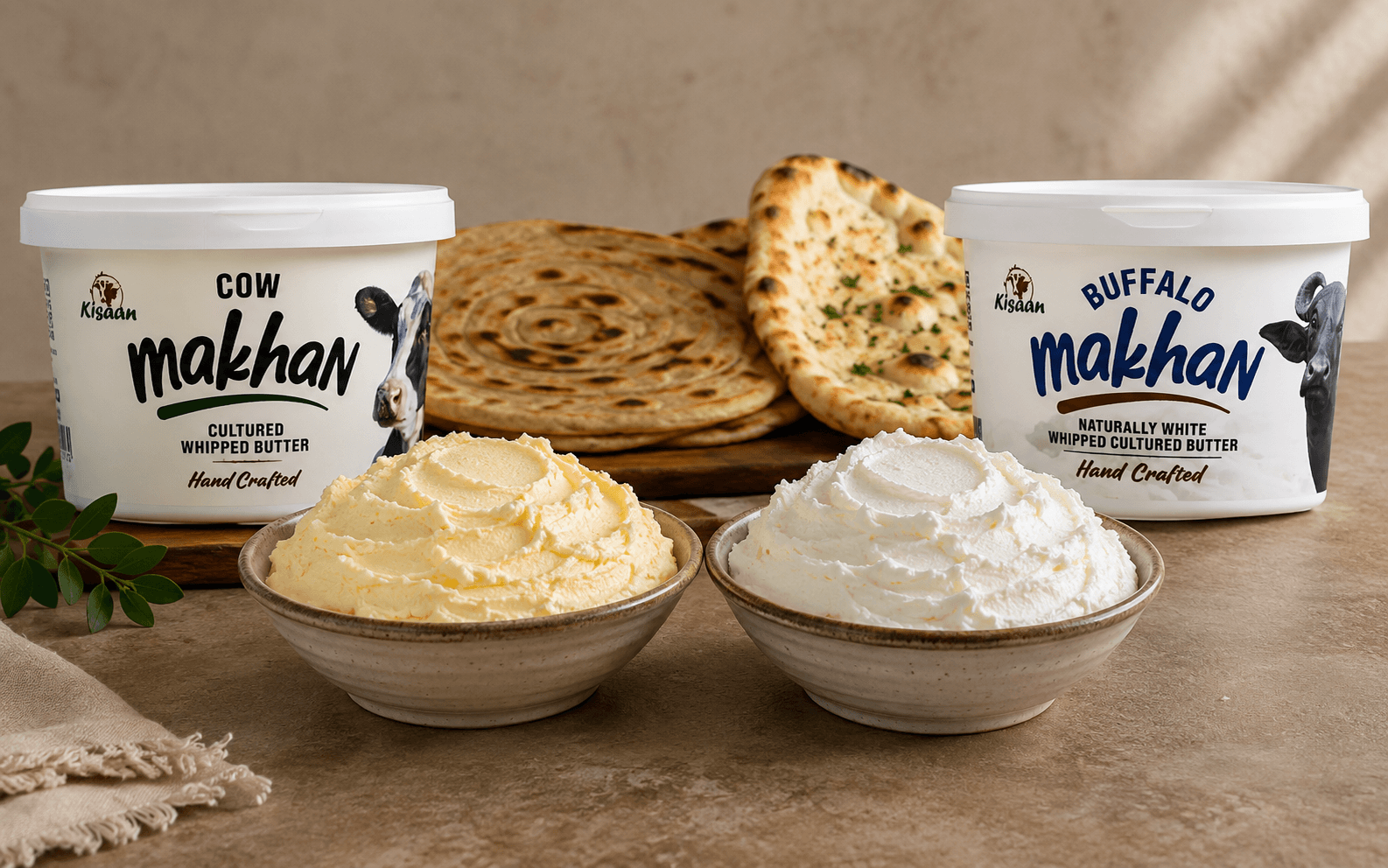
Cow Makhan, made from cultured cow cream and naturally pale yellowish in colour.
Buffalo Makhan, made using Australian buffalo cultured cream and naturally marble white.
Neither is simply a different version of the other. They are two traditional ways of enjoying Makhan, each with its own character.
If you're new to the subject, our guide to What Is Makhan in Australia? explains what Makhan is and how it fits into Indian dairy traditions.
Why Are There Different Types of Makhan?
Makhan is traditionally associated with butter in Indian food culture, but the milk used to make it can vary.
Cow milk and buffalo milk don't have exactly the same composition or natural characteristics. Those differences can carry through to the cream and eventually to the Makhan made from it.
This is why you can have:
Cow Makhan → made from cow cultured cream
Buffalo Makhan → made from buffalo cultured cream
The difference can be seen in appearance, and depending on the product and preparation, it can also influence the overall texture and flavour experience.
This isn't about one being the "real" Makhan and the other not being real.
Both are Makhan.
The more useful question is: which type of Makhan are you looking for?
Cow Makhan vs Buffalo Makhan at a Glance
Before getting into the details, here's the simple comparison.
Cow Makhan
Buffalo Makhan
Dairy source
Cultured cow cream
Australian buffalo cultured cream
Natural colour
Pale yellowish
Distinct marble white
Texture
Creamy and soft
Creamy, smooth and soft
Flavour
Distinct flavour profile
Distinct flavour profile
Preparation
Slow churning with mild whipping
Slow churning with mild whipping
Colourant
None
None
Artificial flavour
None
None
Preservative
None
None
Traditional association
Cow Makhan
White Makhan / White Butter
The table gives you the quick answer.
But the colour difference, dairy source and buying decision are worth understanding in a little more detail.
Why Is Buffalo Makhan White?
This is probably the question that comes up most often when people compare the two.
Why is Buffalo Makhan white while Cow Makhan can look yellowish?
The answer begins with naturally occurring pigments in milk fat.
Cow milk fat generally contains more carotenoid pigments, which can contribute to the yellow or golden tones associated with cow-milk dairy products. Buffalo milk fat contains very little carotene, which contributes to its naturally whiter appearance.
That characteristic can carry through when the cream is turned into butter or Makhan.
So when you see naturally marble-white Buffalo Makhan, the colour doesn't automatically mean that something has been added to make it white.
Traditional white butter made from buffalo milk is well documented as having a naturally white appearance, while butter made from cow milk can have a yellowish appearance.
That's also why Buffalo Makhan is traditionally associated with White Makhan or White Butter.
Why Is Cow Makhan Pale Yellowish?
Cow Makhan can naturally have a pale yellowish appearance.
The reason is again connected to the milk.
Carotenoid pigments present in cow milk fat can contribute to the colour of butter made from cow milk. The amount can also vary depending on factors such as the cow's diet and the composition of the milk. Research on dairy colour confirms that carotenoids are an important contributor to the natural yellow colour of cow-milk butter.
So a pale yellowish Cow Makhan is not something that needs to be "corrected" to make it look white.
For Kisaan Cow Makhan, the pale yellowish colour is part of its natural character.
This is an important distinction when buying Makhan in Australia because someone looking specifically for White Makhan may expect Buffalo Makhan to look very different from Cow Makhan.
Is White Makhan the Same as Buffalo Makhan?
The terms are closely connected, but it's useful to understand what they mean.
White Makhan or White Butter describes the traditional white butter style.
Buffalo Makhan describes Makhan made from buffalo dairy.
Because buffalo milk fat is naturally very low in carotene, buffalo butter is naturally much whiter than typical cow butter.
So when you're specifically looking for the marble-white Makhan traditionally associated with buffalo dairy, Buffalo Makhan is the variety to look for.
For Kisaan, this means:
Kisaan Buffalo Makhan = the marble-white Makhan option.
Does Cow Makhan Taste Different From Buffalo Makhan?
It can.
But it's better to think of the difference as a different dairy character, rather than trying to declare one universally better.
Milk composition affects the resulting dairy product, and buffalo milk generally contains more total solids and fat than cow milk.
Those differences can contribute to how the finished butter or Makhan behaves and feels.
Kisaan describes both varieties as having their own distinct flavour profiles.
The best way to decide which one you prefer is actually quite simple:
Try them.
If you've always eaten Cow Makhan, Buffalo Makhan may feel different.
If you're used to traditional White Makhan, Cow Makhan may look and taste different from what you remember.
That's part of the appeal of having both options.
What About Texture?
Texture is another area where the milk source can make a difference.
Kisaan Cow Makhan is described as having a creamy and soft texture.
Kisaan Buffalo Makhan is described as creamy, smooth and soft.
The two aren't intended to be identical.
Buffalo milk naturally has a higher concentration of milk solids and fat than typical cow milk, which can influence the physical characteristics of dairy products made from it.
But texture is also influenced by the way the product is processed and handled.
That's why it's better to look at the complete product—milk source, cream, churning method and finished texture—rather than assuming the milk source alone determines everything.
How Are Cow Makhan and Buffalo Makhan Made?
The basic idea behind Makhan is beautifully simple.
Cream is churned until the butter comes together.
But the process used by a producer can differ.
For Kisaan, both varieties begin with cultured cream.
Cow Makhan
Kisaan Cow Makhan is specially handcrafted by slow churning cultured cream with a mild whipping process.
The process produces a soft, creamy Makhan with its naturally pale yellowish appearance and distinct flavour profile.
Buffalo Makhan
Kisaan Buffalo Makhan is specially handcrafted by slow churning Australian buffalo cultured cream with a mild whipping process.
The finished product has a distinct marble-white colour with a creamy, smooth and soft texture.
So although the two varieties come from different dairy sources, the broad approach to preparing them is similar.
If you've never looked closely at how Makhan is made, "cultured cream" may sound unfamiliar.
Cream is the rich portion of milk used to make butter and other dairy products.
When cream is cultured, beneficial dairy cultures are used as part of the process before it is turned into the finished product.
For Makhan, cultured cream forms the starting point before the churning process.
The important thing for a shopper is that the cream used and the way it is processed are part of the product's character.
That's why two products can both be called butter or Makhan and still have noticeably different characteristics.
Is One More Traditional Than the Other (Cow Makhan or Buffalo Makhan)?
This question needs a little care.
Indian dairy traditions have used both cow and buffalo milk for generations, and Makhan can be made from either.
In many North Indian households, buffalo milk and buffalo-derived dairy have a strong cultural association, while cow dairy is also deeply established in Indian food traditions.
So it wouldn't be accurate to say that only Buffalo Makhan is traditional or only Cow Makhan is traditional.
Both have a place.
What is particularly associated with Buffalo Makhan is its naturally white appearance, which is why the term White Makhan or White Butter is so familiar.
Is Buffalo Makhan Better Than Cow Makhan?
There isn't a universal answer.
"Better" depends on what you're looking for.
If you want the traditional marble-white appearance associated with White Makhan, Buffalo Makhan is the obvious choice.
If you prefer Cow Makhan and its naturally pale yellowish colour, Cow Makhan may be exactly what you're looking for.
If you're choosing based on how you grew up eating Makhan, your preference may already be decided.
And if you've never tried either, there's nothing wrong with trying both.
The important thing is not to turn a natural difference into a competition.
Cow Makhan and Buffalo Makhan are different products with different characteristics.
Which Makhan Should You Choose?
Here's the simplest way to think about it.
Choose Buffalo Makhan if you want:
Traditional White Makhan
Naturally marble-white Makhan
Buffalo dairy
Australian buffalo cultured cream
Creamy, smooth and soft texture
Choose Cow Makhan if you want:
Cow Makhan
Naturally pale yellowish Makhan
Cow dairy
A distinct flavour profile
Creamy and soft texture
And if you still can't decide?
Try both.
Your preference may come down to something as simple as the flavour and texture you enjoy most with your favourite food.
Which One Is White Makhan?
Buffalo Makhan is the variety associated with White Makhan.
The reason is primarily the natural colour of buffalo milk fat.
Buffalo milk fat contains very little carotene compared with cow milk fat, which contributes to the naturally white appearance of buffalo butter.
So if you're searching for:
White Makhan
White Butter
Buffalo White Butter
Buffalo Makhan
you're generally looking for this traditional buffalo-derived style.
For a deeper explanation of White Makhan, you can read Kisaan's dedicated White Makhan guide.
Can You Use Both Makhan Varieties With Indian Food?
Absolutely.
Makhan doesn't need a completely different recipe depending on whether it's made from cow or buffalo dairy.
Both can be enjoyed with familiar Indian foods.
Paratha
A hot paratha and soft Makhan are a classic combination.
Roti
Makhan works just as naturally with freshly cooked roti.
Naan
Try it with warm naan, particularly alongside a favourite curry.
Dal Makhani
Makhan has a natural place alongside Dal Makhani and other rich Indian dishes.
Paneer
It can also be enjoyed with paneer-based dishes.
Curries
Both varieties can accompany everyday curries and home-style meals.
The choice of Cow or Buffalo Makhan is therefore more about the dairy characteristics you prefer than about completely different culinary uses.
Cow Makhan vs Buffalo Makhan for Everyday Use
If you're buying Makhan for your family, don't overthink the decision.
Consider what you're already familiar with.
If your family remembers the white Makhan served with parathas, Buffalo Makhan may be the natural place to start.
If you're accustomed to the softer yellowish appearance of cow-milk butter, Cow Makhan may feel more familiar.
You can also keep both in the rotation.
For example, you might prefer Buffalo Makhan when you're specifically looking for White Makhan and use Cow Makhan when that's the variety you have available.
There doesn't need to be a strict rule.
Kisaan Cow Makhan
Kisaan Cow Makhan is specially handcrafted by slow churning cultured cream with a mild whipping process.
It has a naturally pale yellowish colour, a distinct flavour profile and a creamy, soft texture.
The product is made without preservative, colourant or artificial flavour.
Kisaan positions its dairy around Australian sourcing, and the current product page identifies cultured cream sourced from farmers in the Goulburn Valley.
For someone looking specifically for Cow Makhan in Australia, this is the variety to explore.
The natural colour is the most obvious visual difference between these two Kisaan varieties.
Buffalo Makhan
Marble white
Cow Makhan
Pale yellowish
But appearance shouldn't be the only thing you use to identify a product.
The best approach is to check the product name and description as well.
That's especially important because the colour of dairy products can vary naturally depending on milk composition, feed and processing. Research on butter colour shows that cow-milk butter can have varying degrees of yellow colour, with carotenoid content and processing both contributing to the final appearance.
So colour is a useful clue—not the only thing that matters.
Does Natural Colour Mean Anything About Quality?
Not necessarily.
A white Makhan isn't automatically better because it is white.
And a yellowish Makhan isn't inferior because it isn't white.
The colour is primarily telling you something about the natural characteristics of the dairy.
That's important because food colour can sometimes create the impression that one product has been altered to look a certain way.
With Kisaan's two Makhan varieties, the intention is different: the natural character of the respective dairy is part of the product.
What About Added Colour?
Traditional butter terminology can be confusing because commercial butter products can sometimes contain added colour, while "white butter" can refer to butter made without added colour.
Food science references distinguish white butter from table butter partly by the absence of added colouring and other additions.
For Kisaan's Buffalo and Cow Makhan, the product descriptions you provided specify that they are free from colourant, preservative and artificial flavour.
So the marble-white appearance of Buffalo Makhan and pale yellowish appearance of Cow Makhan should be understood as part of their natural product character rather than as two products being artificially made to look alike.
Cow Makhan or Buffalo Makhan: A Simple Decision
Still wondering which one to buy?
Use this quick guide.
I want White Makhan. → Buffalo Makhan
I want naturally marble-white Makhan. → Buffalo Makhan
I want Buffalo dairy. → Buffalo Makhan
I want Cow Makhan. → Cow Makhan
I prefer naturally pale yellowish Makhan. → Cow Makhan
I want something soft and creamy for paratha or roti. → Either can work.
There's no complicated formula.
Choose the dairy source and natural character you prefer.
Where Can You Buy Cow and Buffalo Makhan in Australia?
Once you've decided which variety you want, the next question is where to find it.
Kisaan Makhan is now available through local grocery stores across Australia.
That means customers can look for Kisaan Cow Makhan and Buffalo Makhan through local grocery retailers that stock the range.
For customers in Melbourne, Kisaan also offers home delivery, making it possible to order dairy directly to your home.
You can therefore choose the buying option that works best for you:
Local grocery store → across Australia
Kisaan home delivery → Melbourne
If you're ready to compare your buying options, our guide to buying Makhan in Australia covers where to find Kisaan Makhan through local grocery stores across Australia and home delivery options for Melbourne customers.
The Bottom Line
Cow Makhan and Buffalo Makhan are not two names for exactly the same product.
They begin with different dairy sources, and that difference can be seen most clearly in their natural colour.
Cow Makhan can have a naturally pale yellowish appearance.
Buffalo Makhan has a naturally marble-white appearance and is traditionally associated with White Makhan.
Both can be made from cultured cream and slowly churned to create the soft, creamy character associated with Makhan.
So which one should you choose?
If you're looking for the traditional White Makhan experience, Buffalo Makhan is the natural choice.
If you prefer the character of Cow Makhan, choose the cow variety.
And if you've never tried both, there may be no better way to decide than to put them on a hot paratha and see which one belongs on your table.
What is the difference between Cow Makhan and Buffalo Makhan?
Cow Makhan is made from cultured cow cream, while Buffalo Makhan is made using Australian buffalo cultured cream. At Kisaan, Cow Makhan has a naturally pale yellowish colour, while Buffalo Makhan has a distinct marble-white colour. Both are slowly churned with a mild whipping process and have a soft, creamy character.
Which Makhan is White Makhan?
Buffalo Makhan is traditionally associated with White Makhan or White Butter. Kisaan Buffalo Makhan has a naturally distinct marble-white colour because it is made using Australian buffalo cultured cream.
Why is Buffalo Makhan white while Cow Makhan is yellowish?
The natural colour comes from the dairy source. Buffalo milk fat contains very little carotenoid pigment, while cow milk fat generally contains more, which contributes to the yellow or golden tones seen in cow-milk dairy products. This is why Kisaan Buffalo Makhan is naturally marble white, while Kisaan Cow Makhan is naturally pale yellowish.
Does Kisaan Buffalo Makhan contain added colour?
Does Kisaan Buffalo Makhan contain added colour?
Does Kisaan Cow Makhan contain added colour?
No. Kisaan Cow Makhan is also made without colourant, preservative or artificial flavour. Its pale yellowish appearance is its natural colour.
Does Cow Makhan taste different from Buffalo Makhan?
They can have different flavour profiles because they are made from different types of dairy. Kisaan describes both Cow Makhan and Buffalo Makhan as having their own distinct flavour profile, along with a creamy and soft texture.
Which is better, Cow Makhan or Buffalo Makhan?
Neither is universally better. It depends on what you prefer. If you're looking for the traditional marble-white character of White Makhan, Kisaan Buffalo Makhan is the natural choice. If you prefer Cow Makhan and its naturally pale yellowish colour, Kisaan Cow Makhan may suit you better.
How is Kisaan Cow Makhan made?
Kisaan Cow Makhan is specially handcrafted by slow churning cultured cream with a mild whipping process. The finished Makhan has a creamy, soft texture and naturally pale yellowish colour.
How is Kisaan Buffalo Makhan made?
Kisaan Buffalo Makhan is specially handcrafted by slow churning Australian buffalo cultured cream with a mild whipping process. It has a distinct marble-white colour with a creamy, smooth and soft texture.
Where can I buy Kisaan Cow Makhan and Buffalo Makhan in Australia?
Kisaan Makhan is available through local grocery stores across Australia. For customers in Melbourne, Kisaan also offers home delivery. Individual grocery store availability can vary, so customers looking for a particular variety should check with their local retailer.